| |
 |
| |
Comprehensive and Powerful |
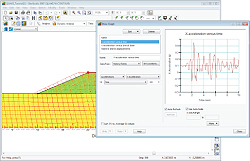
QUAKE/W is a geotechnical finite element software product for the dynamic analysis of earth structures subjected to earthquake shaking, or point dynamic forces from a blast or a sudden impact load. Using QUAKE/W, you can determine the motion and excess pore-water pressures that arise due to shaking. Its comprehensive formulation makes QUAKE/W well suited to analyzing a wide range of problems.
Generalized material property functions allow you to use any laboratory or published data. Three constitutive models are supported: a Linear-Elastic model, an Equivalent Linear model, and an effective stress Non-Linear model. QUAKE/W uses the Direct Integration Method to compute the motion and excess pore-water pressures arising from inertial forces at user-defined time steps. |
| |
Typical Applications |
|
QUAKE/W can model the dynamic behaviour of almost any earth structure, including:
- Earth embankment dams
- Natural soil and rock slopes
- Loose ground deposits
- Estimation of post-earthquake deformation
- Impact loads from dynamic blasting
- Any natural, near-horizontal ground sites with potential for excess porewater pressure generation during earthquake shaking
- 이외에 더 많은 기능들이 있습니다.
|
|
(큰 이미지 보기 ☞ click) |
|
| |
Features |
|
- Linear analysis using Linear-Elastic soil properties
- Equivalent Linear analysis, which varies soil properties for successive iterations (Damping Ratio and GModulus vary with cyclic strain for successive iterations)
- Generalized data point functions for specifying material properties, including functions for overburden correction function (Ks), shear stress correction (Ka), cyclic number, pore pressure, damping ratio, and G modulus reduction
- Imported earthquake records; both horizontal and vertical acceleration vs. time records can be used
- Scale peak acceleration and time duration of imported earthquake records for site-specific conditions
- Boundary condition types include X and Y displacements, forces, pressures, and spring constants, as well as stress, fluid pressure, and self-weight gravity loading
- Definition of liquefaction potential using a collapse surface and steady-state strength
- Structural elements for soilstructure interaction; specifying both axial and flexural stiffness can affect the dynamic response of the system
- History nodes show complete record of displacement, velocity and acceleration
- Many ways to view results, including x-y plots, contours, deformed mesh, animation, spectral analysis, data tables, and Mohr circles
- View most result parameters for static conditions, dynamic conditions, or both
- View displacements, velocities and accelerations as relative values (the finite element results) or as absolute values (the results added to the earthquake record)
|
|
|
|
|
|