



Background Information
Questions:
- What friction models are used in RAMMS?
- When and why does the Voellmy model work well?
- Why use a hydrograph for debris flow modelling?
- What numerical solution technique does RAMMS use?
- How long does it take to perform a simulation?
For more information about important terms please consult the glossary.
RAMMS employs a Voellmy-fluid friction model. This model divides the frictional resistance into two parts: a dry-Coulomb type friction (coefficient μ ) that scales with the normal stress and a velocity squared drag (coefficient ξ) . The frictional resistance S (Pa) is then
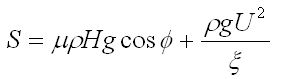
where ρ is the flow density, g gravitational acceleration, φ the slope angle, H the flow height and U the flow velocity. This model has found wide application in the simulation of mass movements, especially snow avalanches. The Voellmy model has been in use in
Avalanches:
The Voellmy model ? coupled with the calibrated parameters ? can be used to (1) predict the runout distance and (2) predict the maximum flow velocity of extreme, large snow avalanches. This is one of the important research results from the Vallee de la Sionne test site.
The Voellmy parameters that we recommend describe the front of a dry-snow avalanche. Because the front defines the runout distance and maximum velocity the Voellmy model will work.
However, the Voellmy model will not describe the avalanche flow behind the front, at the tail of the avalanche. Here, measurements show an increase in the friction (a rapid decrease in speed). This effect causes avalanches to elongate and eventually deposit mass. Therefore, the Voellmy model will not predict the deposition behaviour. The Voellmy model has difficulties to predict the runout of small avalanches, which sometimes begin immediately to deposit or “to starve”. Of course, small avalanches can be modelled using higher μ and ξ values, but this is a very ad-hoc approach.
RAMMS uses a second-order, cell-centered, positivity conserving HLLE finite volume scheme. The time integration is given by a Runge-Kutta-Heun method. We are presently working on a parallelized solution. If you need to know more about this, please contact the developers.
The time required to simulate an avalanche or a debris flow is a function of the finite volume grid resolution and the size of the calculation domain. Typically we use 5m resolutions and the simulations require around 10 minutes. We usually perform the initial simulations at 10 m resolution and therefore we have results in 1 or 2 minutes. When we have a solution that we like we might take a look at the problem at 2m resolution.

